- Laser is an abbreviation ofLight Amplification byStimulated Emission of Radiation.
- Radar is an abbreviation ofRadio Detection And Ranging
- The lightning bolt is 3 times hotter than the Sun.
- The amount of water beneath our ground soil is 50 times as much as all the water in the rivers and lakes combined.
- If you yelled for 8 years, 7 months and 6 days, you would have produced just enoughsound energy to heat up one cup of coffee.
- Lightning strikes about 6,000 times per minute on our planet
- On a clear day, a beam of sunlight can be reflected off a mirror and seen up to 40km away.
- A car travelling at 80km/h uses half its fuel to overcome wind resistance.
- The temperature in fahrenheit can be determined by counting the number of cricket chirps in 14 seconds and adding 40.
- On average, our bodies constantly resist an atmospheric pressure of about 1kg per square cm

It is time for physics facts!

Dispersion of Light Prism

The common wisdom held that white light is the purest form (Aristotle again) and that colored light must therefore have been altered somehow. To test this hypothesis, Newton shined a beam of sunlight through a glass prism and showed that it decomposed into a spectrum cast on the wall. People already knew about rainbows, of course, but they were considered to be little more than pretty aberrations. Actually, Newton concluded, it was these colors — red, orange, yellow, green, blue, indigo, violet and the gradations in between — that were fundamental. What seemed simple on the surface, a beam of white light, was, if one looked deeper, beautifully complex.
Young's light-interference experiment


Newton wasn't always right. Through various arguments, he had moved the scientific mainstream toward the conviction that light consists exclusively of particles rather than waves. In 1803, Thomas Young, an English physician and physicist, put the idea to a test. He cut a hole in a window shutter, covered it with a thick piece of paper punctured with a tiny pinhole and used a mirror to divert the thin beam that came shining through. Then he took "a slip of a card, about one-thirtieth of an inch in breadth" and held it edgewise in the path of the beam, dividing it in two. The result was a shadow of alternating light and dark bands — a phenomenon that could be explained if the two beams were interacting like waves. Bright bands appeared where two crests overlapped, reinforcing each other; dark bands marked where a crest lined up with a trough, neutralizing each other.
The demonstration was often repeated over the years using a card with two holes to divide the beam. These so-called double-slit experiments became the standard for determining wavelike motion — a fact that was to become especially important a century later when quantum theory began. Enjoy reading it people! X
A simple Sound Waves experiment!
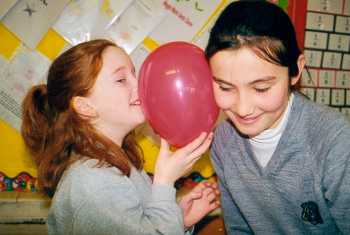
Experiment: To examine (hear and feel) sound vibrations!
Materials: A Partner and a balloon
Method:What you have to do:
1) Blow up the balloon.
2) Hold it against your ear.
3) Ask your partner to press their lips against the balloon and speak.
4) Repeat steps 3 and 4 but this time you should speak and yo
ur friend should listen
Results:You can hear the vibrations through the balloon and you can feel them.
Conclusions: Sound is created when an object moves and the air around it vibrates creating sound waves.
TRY IT!THAT'LL MAKE YOU LEARN SOMETHING AND AFTERALL IT'S AS EASY AS ABC! :)
wallpapers
Hey guys:) i've prepared for you few cool wallpaper for your computer:) feel free to download it:) Have fun:)
If you want more wallpaper, click moreeeee
 |
| Earth.... Human after all |
 |
| Coalescence |
 |
| Evil nebula |
Gravity Facts

- Objects with mass are attracted to each other, this is known as gravity.
- Gravity keeps Earth and the other planets in our solar system in orbit around the Sun. It also keeps the Moon in orbit around Earth.
- Tides are caused by the rotation of the Earth and the gravitational effects of the Moon and Sun.
- Because Mars has a lower gravity than Earth, a person weighing 100kg (220 pounds) on Earth would only weigh 38kg (84 pounds) on Mars.
- It is thought that Isaac Newton’s theories on gravity were inspired by seeing an apple fall from a tree.
- While Newton’s older law of universal gravitation is accurate in most scenarios, modern physics uses Albert Einstein’s general theory of relativity to describe gravity.
- Acceleration of objects to due to the gravity on Earth is around 9.8 m/s2. If you ignore air resistance (drag) then the speed of an object falling to Earth increases by around 9.8 metres per second every second.
- The force of gravity 100 kilometres (62 miles) above Earth is just 3% less than at the Earth’s surface.
- The human body can handle increased g-forces as seen in activities such as dragster races, airplane acrobatics and space training. The highest known acceleration voluntarily experienced by a human is 46.2 g by g-force pioneer John Stapp.
- While formula one racing drivers may feel around 5 g’s under heavy braking, they can experience over 100 g’s if a crash causes them to decelerate extremely quickly over a very short distance.
- Some roller coasters have been known to include g-forces of around 4 to 6 g.
- The higher something is, the greater its gravitational potential energy. Back in the Middle Ages, weapons called trebuchets were used to take advantage of this principle, using mechanical advantage and the gravitational potential energy of a counterweight to hurl rocks and other projectiles at or over walls. In modern times we use the gravitational potential of water to create hydroelectricity.
Water Bottle Rocket!

Hey people! Wuzzup? Bored? Nothing exciting to do today? Hey, how about we do an experiment. I bet it will blow your shoes off! The experiment is called water bottle rocket :) It is pretty awesome actually.
A water rocket is a type of model rocket using water as its reaction mass. The pressure vessel—the engine of the rocket—is usually a used plastic soft drink bottle. The water is forced out by a pressurized gas, typically compressed air. It is an example of Newton's third law of motion.
*third law motion: To every action there is always an equal and opposite reaction: or the forces of two bodies on each other are always equal and are directed in opposite directions.
So, here's a video about it:)
- When a rocket is built, it is pressure tested. This is done by filling the rocket completely with water, and then pressurizing it to at least 50% higher than anticipated pressures. If the bottle ruptures, the amount of compressed air inside it (and thus the potential energy) will be very small, and the bottle will not explode.
- Using metal parts on the pressurized portion of the rocket is strongly discouraged because in the event of a rupture, they can become harmful projectiles. Metal parts can also short out power lines.
- While pressurizing and launching the rocket, bystanders are kept at a safe distance. Typically, mechanisms for releasing the rocket at a distance (with a piece of string, for example) are used. This ensures that if the rocket veers off in an unexpected direction, it is less likely to hit the operator or bystanders.
- Water rockets should only be launched in large open areas, away from structures or other people, in order to prevent damage to property and people.
- As water rockets are capable of breaking bones upon impact, they should never be fired at people, property, or animals.
- Safety goggles or a face shield are typically used.
- A typical two-litre soda bottle can generally reach the pressure of 100 psi (690 kPa) safely, but preparations must be made for the eventuality that the bottle unexpectedly ruptures.
- Glue used to put together parts of water rockets must be suitable to use on plastics, or else the glue will chemically "eat" away the bottle, which may then fail catastrophically and can harm bystanders when the rocket is launched.
Subscribe to:
Posts (Atom)